You take a picture of your lunch. An AI identifies rice, dal and sabzi within seconds. Convenient, certainly. But what exactly has the AI understood?
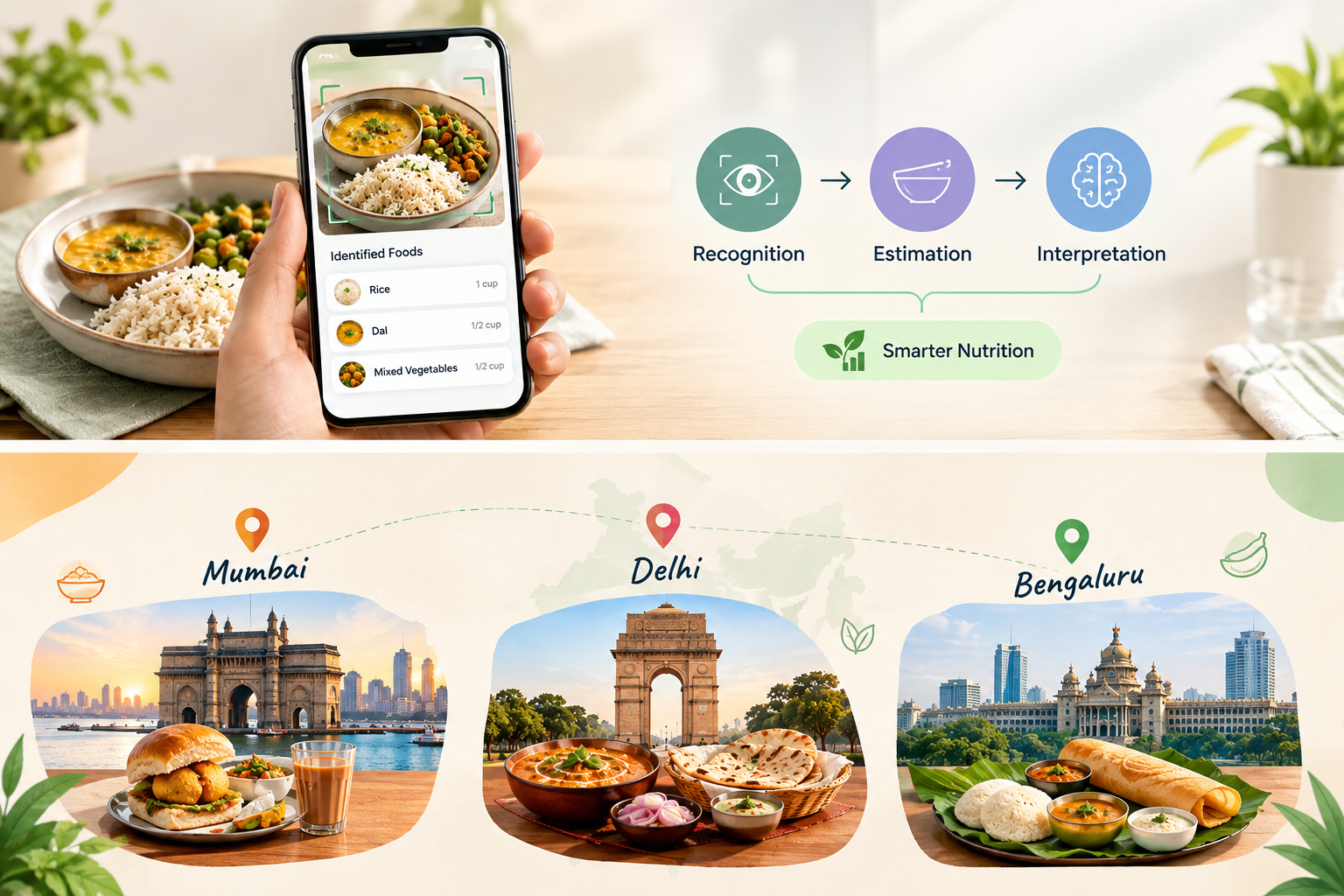
A food recognition app can potentially make recording meals faster, while food recognition AI can identify dishes from photographs. Yet identifying food is only the beginning of understanding it.
At its most basic level, food image recognition uses computer vision and machine-learning models to identify foods or dishes from photographs. Research into automated dietary assessment has explored food identification, portion estimation and nutrient estimation, with deep-learning approaches becoming increasingly important.
This could remove one of the biggest frustrations associated with traditional food tracking: manually searching through databases for every ingredient or dish.
But imagine photographing a bowl of dal. The system may recognise dal. It still needs to estimate how much is in the bowl. It may also need to account for the preparation method, ingredients and added fats before nutritional information can be meaningfully estimated.
Recognition answers one question: What is this? Nutrition tracking has to answer several more.
Portion size is where food recognition becomes considerably more complicated.
A photograph does not come with a weighing scale attached to it. An AI system has to infer quantity from visual information, potentially using the size of a plate, bowl, utensil or another reference object.
Even then, estimation remains imperfect.
Consider two plates containing rice. They may look broadly similar in a photograph while containing very different quantities. The same applies to roti, curry, dal or other foods.
This matters because nutritional values depend on quantity. An accurate identification of a food does not automatically produce an accurate estimate of the nutrients consumed.
A responsible system therefore needs to distinguish between recognising a food and estimating its nutritional contribution rather than presenting an estimate as a precise measurement.
Indian food makes this problem more nuanced because many everyday meals are mixed, layered or highly variable.
A photograph of a thali might show rice, roti, dal, sabzi, raita and curry together. A biryani combines multiple ingredients within one dish. A curry can contain vegetables or meat alongside spices, cooking fats and other ingredients that may not be visually obvious.
Even familiar foods can vary substantially between kitchens.
One roti may be larger than another. Two bowls of dal may use different proportions of lentils, water and tempering. A vegetable dish may be prepared with different quantities of oil.
This means an Indian food recognition app cannot assume that identifying a dish automatically reveals its exact nutritional composition.
The photograph provides valuable information. It simply does not provide all the information.
This is where smarter nutrition tracking needs to evolve.
The first layer is recognition: identifying the food in the image.
The second is estimation: assessing factors such as portion size and potential nutritional values.
The third is interpretation: understanding that information within the individual's wider eating pattern.
That final layer is arguably the most important.
A photograph of a rice-based meal does not explain whether it is typical of someone's diet, what they ate earlier, what they are likely to eat later, or what their personal nutrition priorities are.
Nutrition is a pattern rather than a collection of isolated photographs.
AI can potentially make the first two layers easier and faster. The greater opportunity is connecting that information to context without pretending that an image alone can answer every nutritional question.
The future of food recognition AI is therefore unlikely to be simply about producing a calorie number faster.
A more useful system could combine visual recognition with additional context such as portion information, preparation, dietary preferences, eating patterns and individual goals.
That changes the experience from repeatedly entering food into a database to capturing information about how someone actually eats.
It also reduces an important source of friction. If technology can recognise the starting point, the user may have less information to enter manually. Additional context can then refine the estimate rather than requiring the person to construct every meal from scratch.
The goal is not perfect automation. It is better information with less effort.
This is where Nutriiya can occupy a more meaningful space than simple food logging.
Real Indian meals are contextual. Their ingredients, portions, preparation and combinations can vary considerably. People's eating patterns are contextual too.
That creates a gap between identifying a meal and making sense of it.
Nutriiya's approach to AI-powered nutrition can sit within that gap by connecting Indian food with individual context and everyday nutrition decisions. Food recognition can help capture what is being eaten; the surrounding nutritional context can help make that information more useful.
That is a fundamentally different proposition from treating every meal as a generic database entry.
AI is likely to become increasingly capable at recognising foods, distinguishing items within images and estimating portions. But better recognition should not be confused with perfect nutritional understanding.
The more interesting question is what happens after recognition.
Can the system account for uncertainty? Can it distinguish a homemade curry from a standard database recipe? Can it understand that two visually similar meals may have different nutritional compositions? Can it place one meal within the context of the person's broader eating pattern?
Those are harder problems than identifying a bowl of dal.
And they point towards the real future of AI-powered nutrition tracking.
A camera can help answer “What is on my plate?” Smarter nutrition technology needs to go further and help answer “What does this meal mean within the way I eat?”
That is the difference between food recognition and nutrition understanding.
Accuracy can vary depending on the food, image quality, portion size, preparation method and nutritional data available to the system. Food recognition should therefore be treated as an aid to tracking rather than an exact measurement.
Food recognition AI uses computer vision and machine-learning techniques to analyse visual characteristics in an image and classify the foods or dishes it detects.
Indian meals can contain multiple ingredients, mixed dishes and recipes that vary between households. A photograph may identify a dish without revealing its exact ingredients, preparation method or portion size.
AI can potentially estimate nutritional information from an image, but the accuracy of that estimate depends on factors such as portion size, preparation and the underlying nutritional data.
The technology is likely to move beyond simple food identification towards combining recognition with portion information, nutritional data and individual context, making tracking more convenient and potentially more meaningful.
Share this blog on: