There is a very Indian assumption hiding at the dinner table: if everyone is eating the same food, everyone must be getting what they need.
Papa gets rice. Mummy gets rice. The teenager gets rice. The gym-going sibling gets rice. Same dal, same sabzi, same roti. Bas, nutrition sorted.
Except… not really.
A growing teenager, an active adult, a desk-bound parent and an older family member can have different nutritional needs. ICMR-NIN recommendations account for differences across age groups and physiological states rather than treating every Indian as nutritionally identical.
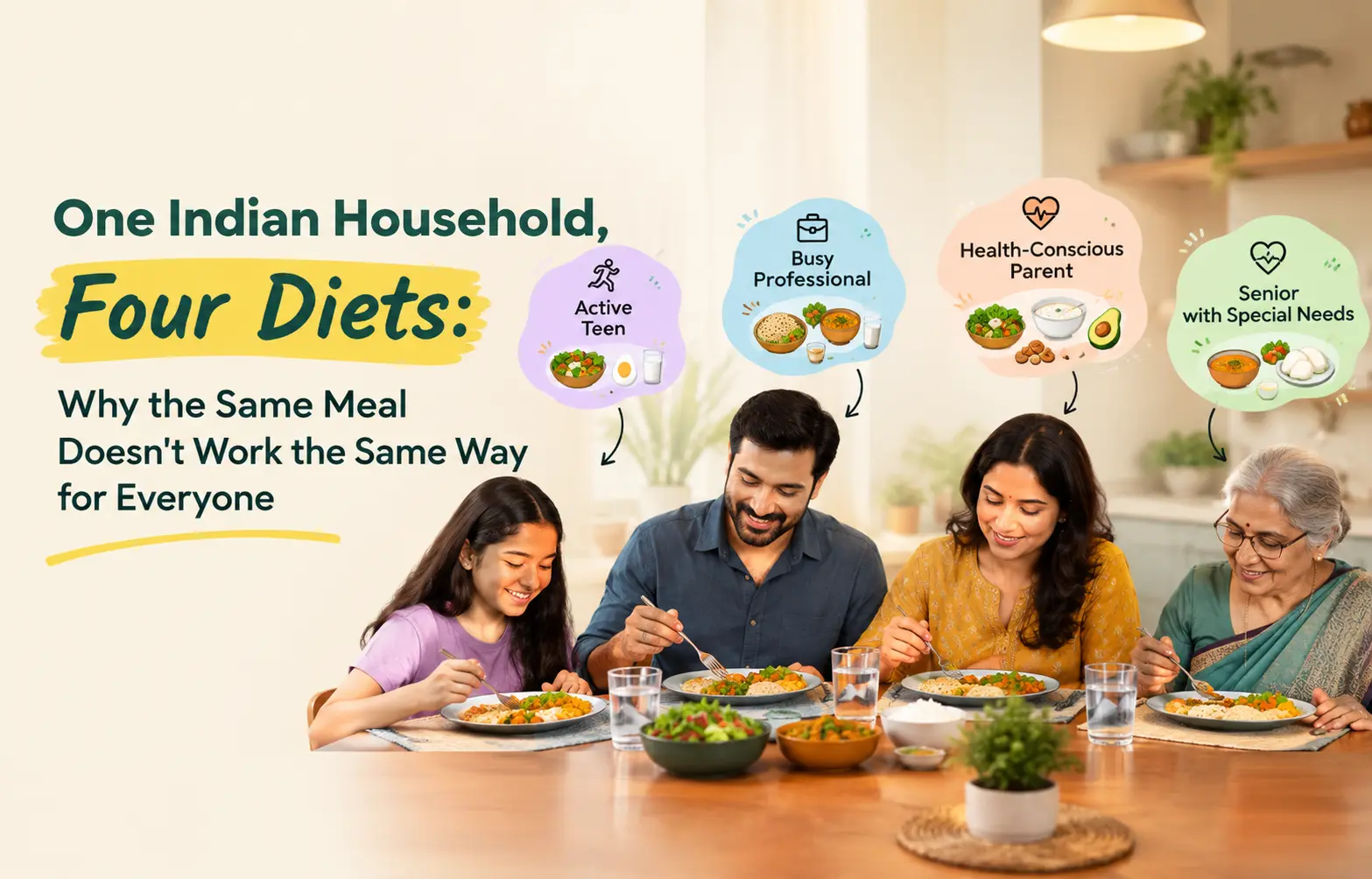
Indian families eat together because it is practical, economical and part of how the household works.
Nobody wants Mummy saying, “Tumhare liye alag banana padega?” because one person wants more protein, another has different energy needs and someone else has suddenly discovered quinoa on Instagram.
The problem is not shared meals.
The problem is assuming shared food means shared nutritional requirements.
Take a ghar ka meal: dal, rice, roti, sabzi and curd.
The teenager may still be growing. The active adult may train regularly. The parent who has spent eight hours in meetings may have a different activity pattern. An older family member may have different nutritional considerations as requirements and eating patterns change with age.
Same kitchen. Same meal. Four different contexts.
Your plate has no idea what happened before dinner.
It does not know that your brother spent two hours at the gym, Dad spent the day in meetings, or Mummy had chai and “bas ek biscuit” at 5 p.m. and somehow called that a snack.
Food is only one part of the equation.
Nutrition also depends on the person eating it, their wider dietary pattern, activity, age and individual circumstances.
The same meal can play a different role for different people.
Personalised nutrition does not mean turning your kitchen into a hotel buffet where everyone places a separate order.
The dal can stay. The sabzi can stay. The roti can stay.
What can change is the portion, combination and context.
One person may need more food because of their activity. Another may need a different balance based on their overall intake.
Someone else may need to consider how that meal fits into everything they have eaten that day.
Research on personalised nutrition suggests tailored dietary advice can improve dietary intake compared with generalized advice, although the evidence is still evolving.
Nutrition can be shared at the table without being identical on every plate.
Here is the uncomfortable truth.
Families often use the same meal as a shortcut for the whole household because it is convenient.
Fair enough. Nobody has time to run a nutrition audit between making rotis and yelling, “Khana thanda ho raha hai!”
But convenience can quietly become an assumption.
The child follows the family routine. The working parent skips lunch because a meeting ran over. The active sibling eats the same portions as everyone else. The older family member continues habits-built decades ago.
Nobody necessarily thinks anything is wrong.
That is precisely the problem.
A family can have excellent food traditions and still overlook individual nutritional needs. Shared cooking is a strength. Treating everyone's requirements as identical is where it can fall short.
Now imagine doing all this manually.
Remember what you ate. Remember the portions. Think about your activity. Then repeat tomorrow.
For most people, that sounds less like taking charge of nutrition and more like accepting a part-time admin job without salary.
This is where technology can reduce some friction.
Nutriiya sits at the intersection of Indian food, individual context and everyday nutrition decisions. The opportunity is not to give every family member different food. It is to make nutrition information more relevant to the person eating the meal.
Because “What did you eat?” is only the starting question.
A better question is: who ate it, what else are they eating, and how does that meal fit into their life?
Family nutrition does not require four kitchens, four menus and four people suspiciously checking each other's plates.
It can start with the meal already sitting on the table.
The teenager may need one approach. The active adult is another. The desk-bound parent is another. The older family member is another.
The food can remain shared. The nutritional decision does not have to be.
Families share food because it makes life easier. They should not assume that sharing food means sharing the same nutritional needs.
Personalised nutrition can begin right there, at the dinner table, with four different people finally being treated like four different people.
No. People living in the same household can have different nutritional requirements depending on factors such as age, activity, body size and physiological state.
Not necessarily. Families can continue sharing meals while adapting portions, combinations and other decisions around individual needs.
Because people do not have identical energy requirements, activity levels or nutritional circumstances. A standard portion may be appropriate for one person and less appropriate for another.
Yes. A meal containing foods such as dal, rice, roti, vegetables and curd can form part of different dietary patterns. What changes is how the meal fits into each person's overall intake and circumstances.
Technology can reduce the effort involved in recording food and understanding eating patterns. It should support better decisions rather than replace qualified professional guidance where individual medical or clinical advice is needed.
Share this blog on: