Most Indian overeating does not begin with a cheat meal. It begins with someone at the table saying, “Bas ek aur roti.”
Then comes, “Itna kam kaise khayega?”
Then, “Ghar ka khaana hai, kuch nahi hota.”
Then, one more spoon of rice, one more ladle of dal, one more piece of paratha, one more cup of chai.
That is the extra roti effect.
It is not about blaming Indian families. It is not about calling Indian food unhealthy. Dal, roti, sabzi, rice, curd, poha, dosa, khichdi and thali can all be part of balanced eating. The problem is not the food itself. The problem is how easily extra portions become normal, emotional and invisible.
For anyone trying to build healthy eating habits, improve weight management or practise better portion control, this matters. Because in Indian homes, overeating often hides inside love, habit and hospitality.
Nutriiya exists for exactly this gap: helping Indian users understand the meals they actually eat, not some ideal diet chart they cannot follow.
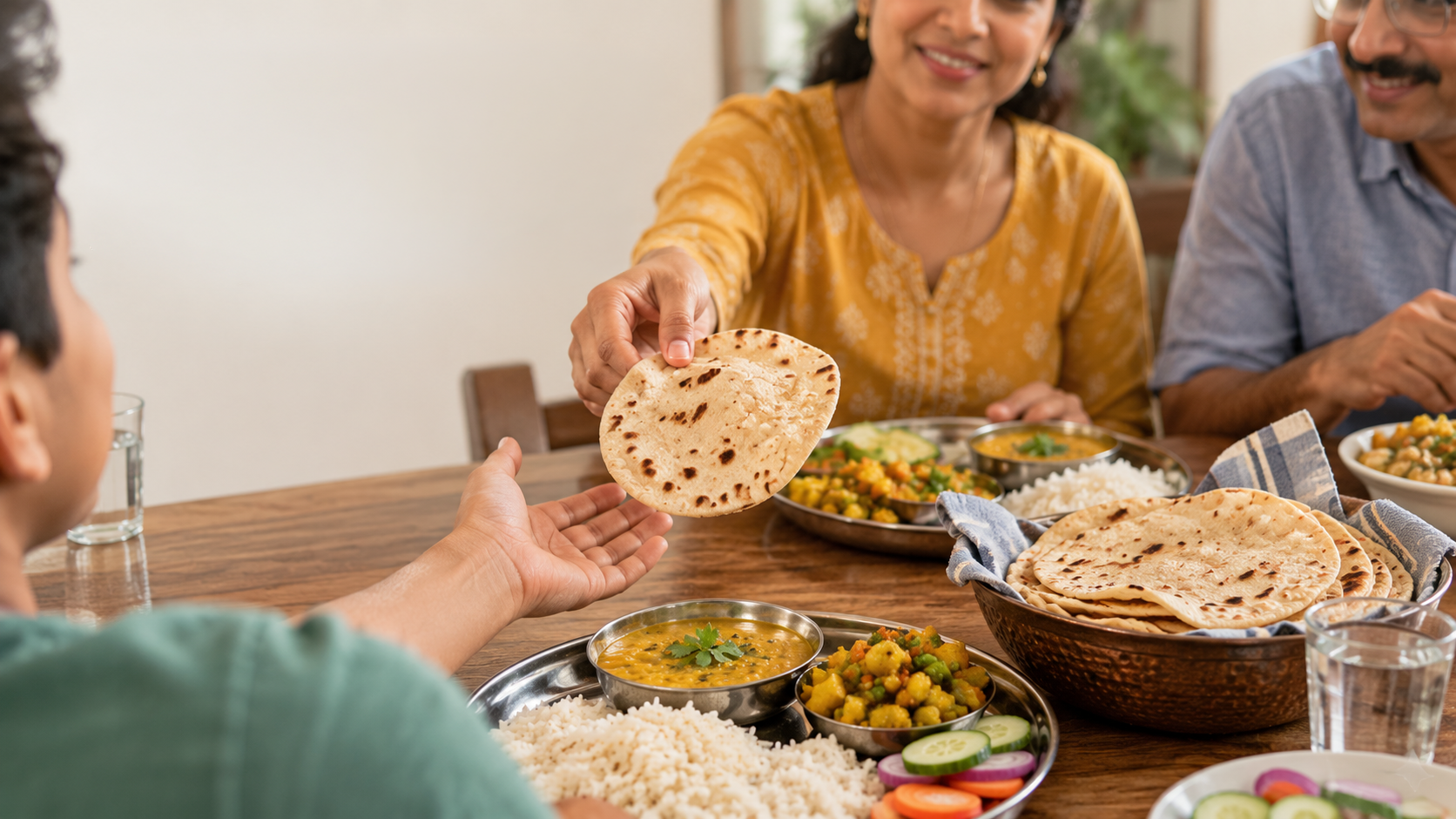
Most people assume overeating looks obvious. Fried snacks. Desserts. Fast food. Late-night ordering. But in many Indian homes, the first plate is not the real issue.
The issue is what happens after the first plate.
One extra roti. A rice refill. Extra sabzi because it is freshly made. More dal because “protein hai.” A spoon of ghee because it is homemade. A second helping of biryani because everyone else is eating. A biscuit with chai that does not feel like food at all.
Individually, these feel harmless. Repeated daily, they become the difference between awareness and excess.
This is why weight management becomes frustrating for many people. They feel they are eating “normal ghar ka khaana” and technically, they are. But normal family portions are not always aligned with one person’s body, hunger, activity level or goal.
That is the uncomfortable truth: homemade food can still be overeating.
In Indian households, food is rarely just nutrition. Food is care. Food is respect. Food is a celebration. Food is an apology. Food is affection.
So, when someone says no to another serving, it can feel personal.
“Diet kar raha hai kya?”
“Plate mein chhodna nahi.”
“Thoda aur kha le.”
“Tu pehle jaisa nahi khata.”
This is where portion control becomes difficult. The decision is no longer just about hunger. It becomes social. Saying no feels rude. Eating more feels easier than explaining yourself.
Over time, this creates a quiet conditioning: a good meal means feeling stuffed, not satisfied. A loving host means refilling the plate. A “healthy appetite” means eating beyond need.
But real healthy eating habits require a different kind of maturity. You do not need to insult family food. You do not need to reject home-cooked meals. You need to stop eating automatically just because food is available, offered or emotionally loaded.
The real problem is not one extra roti. It is not one spoon of rice. It is not one cup of chai.
The real problem is not knowing how often it happens.
This is where Nutriiya becomes useful beyond basic calorie counting. If dinner regularly includes a second serving, Nutriiya helps make that visible. If chai and biscuits quietly add calories every evening, the pattern starts showing up. If rice and roti are both appearing in the same meal more often than expected, the user can see it. If weekend portions are undoing weekday effort, the logs reveal it.
Better weight management is not built on memory. Memory lies. Most people underestimate what they eat because small additions do not feel like real intake.
A nutrition tracker built for Indian food helps users move from “I think I eat okay” to “Now I can actually see my pattern.”
That shift matters.
The solution is not to fear Indian food or replace every meal with salad. That is lazy advice, and it does not survive Indian homes.
The smarter approach is smaller corrections.
Eat two rotis instead of three. Choose rice or roti when the meal is already heavy. Reduce sugar in chai. Track ghee honestly. Take sabzi first, then decide if you need more roti. Pause before accepting a refill. Ask yourself whether you are still hungry or just responding to pressure.
This is portion control without drama.
The goal is not perfection. It is visibility. Once users understand where extra intake is coming from, they can make better decisions without guilt, panic or extreme dieting.
Nutriiya supports that shift by helping users build healthy eating habits around real Indian food, real portions and real family patterns.
The extra roti effect is powerful because it feels harmless. It hides inside care, routine and family comfort. Nobody notices it because nobody thinks of it as overeating.
But repeated small extras shape the body more than occasional big mistakes.
Indian food does not need to be feared. It needs to be understood. The goal is not to make Indian families eat less with guilt. It is to help people eat with visibility.
Nutriiya helps users see what their meals, portions and repeated patterns are doing. Not to create anxiety, but to create awareness.
Because the real shift is not from roti to salad.
It is from automatic eating to aware eating.
The extra roti effect refers to how small extra servings, like one more roti, extra rice, more dal or another cup of chai, become normal in Indian homes. These additions may look harmless, but over time they can affect weight management and eating awareness.
No. Indian food is not the problem. The real issue is often unclear portions, hidden oil or ghee, repeated servings and snacks that go unnoticed. With better portion control, Indian meals can fit into balanced healthy eating habits.
Start with simple changes: serve the first plate mindfully, pause before second servings, track rice and roti together, reduce sugary chai and notice snacks. Portion control does not mean eating less with fear. It means eating with awareness.
Nutriiya helps users track real Indian meals like roti-sabzi, dal-rice, khichdi, dosa-sambar, poha, biryani and thali through AI-powered meal scanning and manual logging. It helps users understand calories, nutrients and repeated eating patterns more clearly.
Share this blog on: