Most nutrition tracker apps can remember what you ate.
That sounds useful until you realise they may still need you to explain the same breakfast tomorrow.
Poha on Monday. Logged.
Poha on Tuesday. Logged again.
Poha on Wednesday. At this point, even the app should know this is a pattern.
That is the difference between remembering and learning.
A tracker can record individual meals. But real people do not eat like spreadsheets. We repeat meals, follow routines, change our food when work gets hectic and develop preferences that stick around.
The bigger question is whether technology can use that history to make future tracking more relevant.
That is where adaptive personalisation gets interesting.
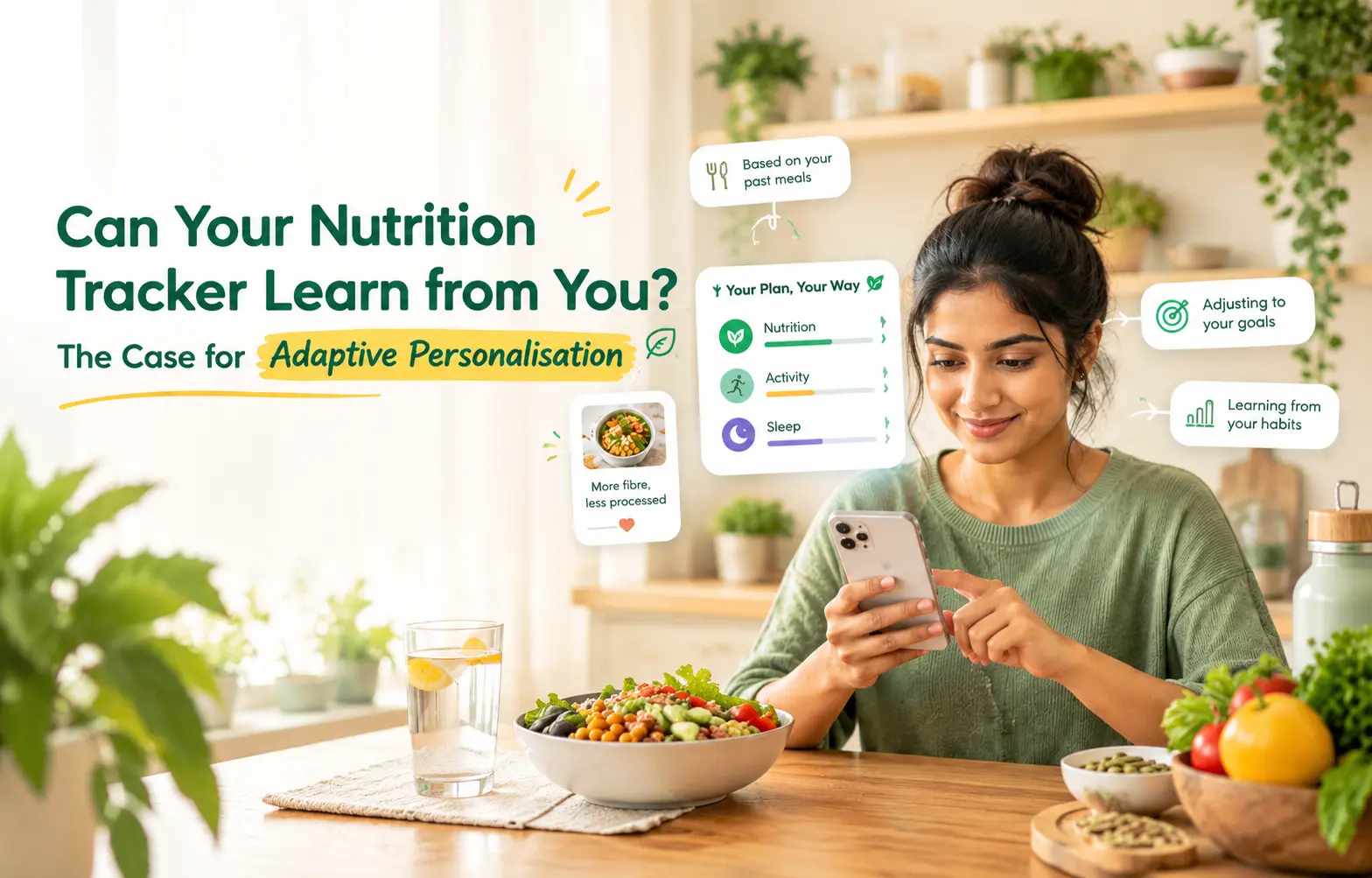
Think about a normal Indian week.
Monday morning is poha because you must leave early. Tuesday is poha because nobody has time for drama before work.
Friday might be office lunch. Sunday suddenly becomes paratha because Sunday has its own rules.
Then there is the 5 p.m. chai.
Every. Single. Day.
These are not just separate food entries. They form a pattern.
A tracker that records seven breakfasts sees seven breakfasts. A more adaptive approach can recognise that those meals are part of a recurring routine.
And that matters because personalised nutrition is not about making every meal complicated. It is about making nutrition information more relevant to the person using it.
There is a simple difference between recording and learning.
The recording says: “You ate two rotis, dal and sabzi.”
Learning from the pattern asks: “Is this a meal you regularly eat? Does the portion usually change? Is it part of a weekday routine? Has your eating pattern changed recently?”
Here, “learning” does not have to mean an AI system magically retraining itself around your life.
It can simply mean using relevant information from previous interactions to make future interactions more contextual.
That creates a useful progression: record what happened, recognise recurring patterns, consider relevant context, and make the next interaction more useful.
That is where AI nutrition becomes interesting.
Not because putting AI into an app automatically makes nutrition smarter.
Because technology becomes more useful when it can work with the context people have already provided instead of treating every meal like a brand-new introduction.
There is another problem with static tracking: people change.
Your weekday breakfast might be rushed because the office commute has already eaten into your morning. Saturday breakfast can take its sweet time.
Lunch may look different when you work from home. Dinner may change when relatives drop in. Your routine may shift when you start exercising regularly or change your goals.
So adaptive personalisation is not simply about remembering yesterday.
It is about recognising that yesterday may no longer describe today.
A useful system should not treat old information as a permanent instruction manual. Relevant patterns can change, and personalisation must leave room for that.
The goal is not to predict your next meal like an overly confident astrologer.
It is to make the next interaction more relevant because the system has useful context from previous ones.
Here is the slightly ridiculous part of nutrition tracking.
You can enter the same meal ten times, yet tomorrow you may still have to explain it from scratch.
Imagine your music app forgetting your favourite songs every morning.
You would uninstall it before breakfast.
Nutrition tracking can create the same friction. Repeatedly entering familiar meals, preferences and routines can turn something meant to be helpful into admin work.
And nobody signed up for a second job just to confirm that, yes, they had two rotis again.
An adaptive system could use relevant information from previous interactions to reduce unnecessary repetition and make future tracking more contextual.
Not because it knows you better than you know yourself.
Because it has stopped pretending yesterday never happened.
Indian eating habits make this especially interesting.
Our meals are rarely neat little boxes.
Breakfast could be poha, idli, paratha, eggs or yesterday's leftovers. Lunch could be ghar ka khana, office food, a thali or something ordered because, “Aaj cooking ka mood nahi hai.”
Then there are family meals, festivals, travel, chai breaks and weekends that seem to operate under completely different laws.
This combination of repetition and variety makes context important.
A useful nutrition experience needs to work with the way people actually eat, rather than expecting every meal to arrive as a perfectly measured, neatly labelled entry.
That is the space Nutriiya is built around: real Indian food habits and everyday nutrition decisions.
The opportunity is not simply to collect more food entries. It is to make those entries more meaningful when viewed as part of an individual's broader eating pattern.
Adaptive personalisation is therefore better understood as a direction for smarter nutrition technology, not a magic button that suddenly understands everything about you.
More data is easy.
Better context is harder.
A tracker that remembers your meals gives you a diary.
A more adaptive system can potentially use relevant patterns from that diary to make future interactions more contextual.
That is where personalized nutrition can become more useful.
You should not have to keep explaining that Monday is poha day, Friday is office lunch and Sunday is when the paratha negotiations begin.
Your eating habits have continuity.
Your tracker should be able to work with that continuity too.
Because the smarter future of nutrition tracking may not be about collecting everything you eat.
It may be about understanding the difference between what you ate once and how you actually eat.
Adaptive personalisation means using relevant information from previous interactions, repeated habits and changing context to make future nutrition tracking or guidance more relevant.
Regular tracking primarily records what someone eats. Personalised nutrition considers relevant information about the individual and their eating patterns rather than treating every person the same.
AI can potentially help organise, interpret and personalise information within nutrition-tracking experiences. Its usefulness depends on the information available and the capabilities of the specific system.
Indian meals can involve mixed dishes, varied recipes, regional foods, changing portions and shared family meals. This makes context particularly useful when understanding eating patterns.
Nutriiya is an AI-powered nutrition platform built around real Indian food habits and everyday nutrition decisions, with a focus on making nutrition more contextual and relevant to individual users.
Share this blog on: